Multilingual Text-to-Speech: Top 7 AI Tools

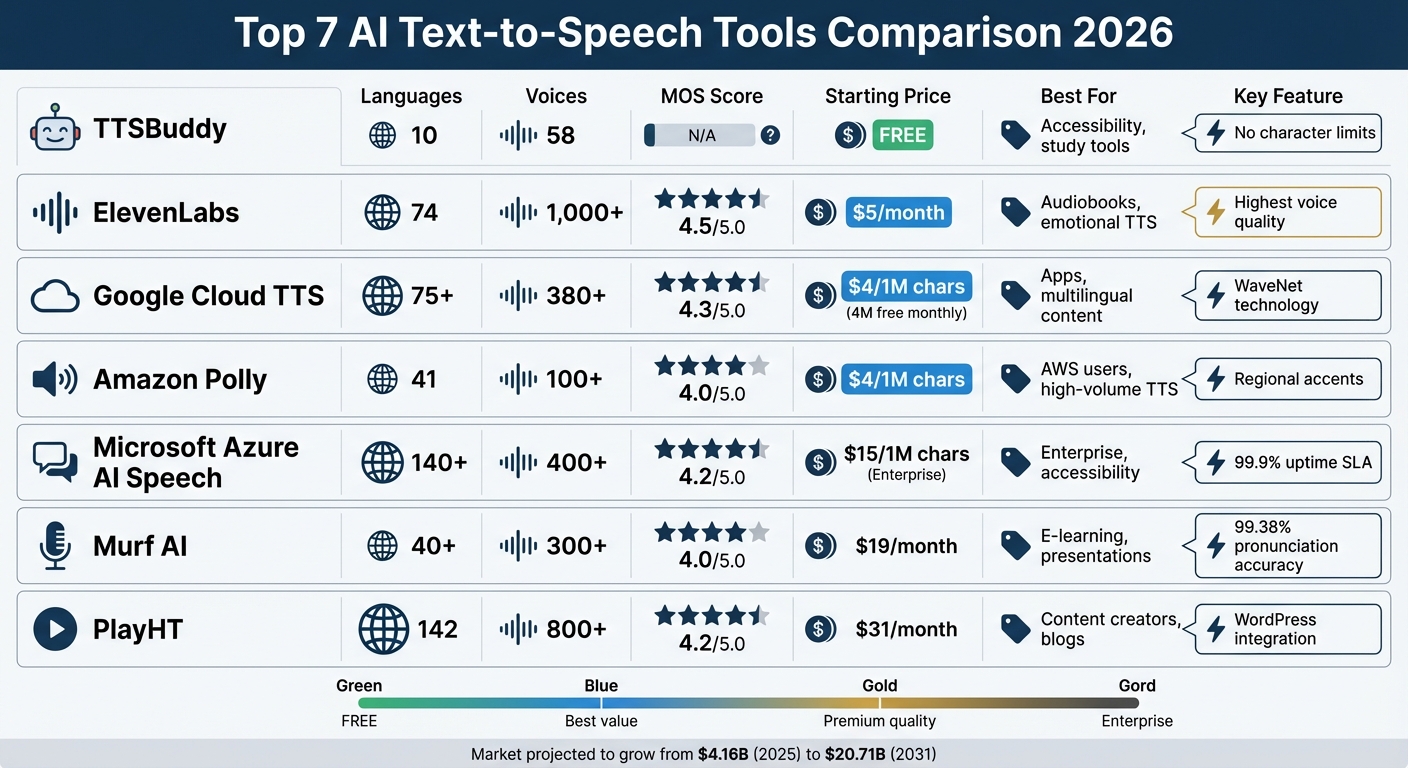
AI-powered text-to-speech (TTS) tools have advanced significantly by 2026, delivering speech quality nearly indistinguishable from human voices. These tools support 100+ languages, regional accents, and even emotional nuances, making them essential for businesses, educators, and accessibility advocates. Below are the seven leading TTS platforms, each offering unique features:
- TTSBuddy: A completely free tool with 300+ voices across 30+ language modes, focused on accessibility with no character limits.
- ElevenLabs: Offers 1,000+ voices across 74 languages, excelling in lifelike voice quality and emotional depth. Flexible subscription plans cater to casual users and professionals.
- Google Cloud TTS: Provides 380+ voices in 75+ languages, with customizable options like WaveNet and Polyglot voices. A free tier covers up to 4 million characters monthly.
- Amazon Polly: Supports 100+ voices in 41 languages, with regional accents and tools for syncing audio with visuals. Ideal for AWS integrations and high-volume needs.
- Microsoft Azure AI Speech: Features 400+ voices in 140+ languages, offering enterprise-grade reliability and advanced customization for accessibility.
- Murf AI: Includes 300+ voices in 40+ languages, with tools for word-level editing and eLearning. Affordable plans start at $19/month.
- PlayHT: Covers 142 languages with 800+ voices, offering instant voice cloning and seamless integration with WordPress.
These platforms cater to diverse needs, from accessibility and multilingual content creation to real-time applications. Choose based on your priorities - whether it's cost, voice quality, or language support.
Quick Comparison
| Tool | Languages | Voices | Free Option | Starting Price | Best For |
|---|---|---|---|---|---|
| TTSBuddy | 10 | 58 | Yes | Free | Accessibility, study tools |
| ElevenLabs | 74 | 1,000+ | Yes | $5/month | Audiobooks, emotional TTS |
| Google Cloud TTS | 75+ | 380+ | Yes | $4/1M chars | Apps, multilingual content |
| Amazon Polly | 41 | 100+ | Yes | $4/1M chars | AWS users, high-volume TTS |
| Microsoft Azure AI Speech | 140+ | 400+ | Yes | $15/1M chars | Enterprise, accessibility |
| Murf AI | 40+ | 300+ | Yes | $19/month | E-learning, presentations |
| PlayHT | 142 | 800+ | Yes | $31/month | Content creators, blogs |
These tools are transforming how we interact with content globally, offering high-quality, multilingual audio solutions tailored for different industries and use cases.
How to Use ElevenLabs to Create Multilingual Voiceovers (Beginner's Guide)
1. TTSBuddy - Designed for Accessibility
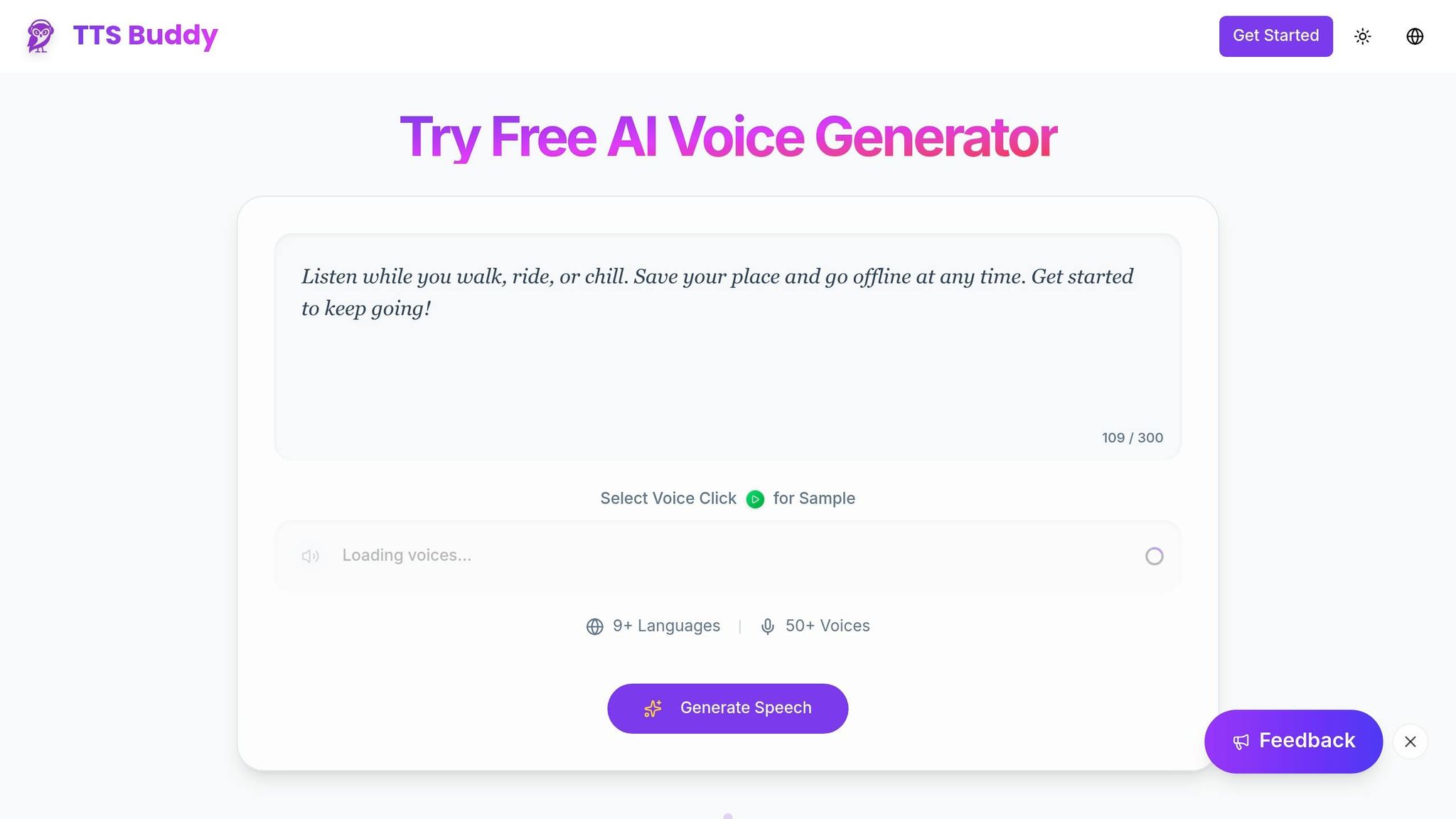
TTSBuddy is a free text-to-speech platform tailored for individuals who rely on accessible tools. It offers 300+ voices across 30+ language modes, including 20 distinct voices in American English. Unlike many platforms, it doesn't hide premium voices behind a paywall, making all options available to users at no cost.
Supported Languages and Voice Options
TTSBuddy organizes its voices into quality tiers to suit different needs. The Premium tier includes voices like Madison and Sophia, which are ideal for long-form listening due to their natural tone and conversational style. The Flash tier focuses on ultra-fast generation while maintaining quality. Beyond English, the platform supports a variety of languages, such as:
- Chinese: 8 voices
- Japanese: 5 voices
- Hindi: 4 voices
- Spanish: 3 voices
- Portuguese: 3 voices
- Italian: 2 voices
- French: 1 voice
Accessibility-Oriented Features
Users can adjust playback speed with five settings, ranging from 0.5x (Very Slow) to 1.5x (Very Fast), allowing for better clarity or quicker consumption. TTSBuddy remembers user preferences, such as voice and speed settings, across sessions. Additionally, the Web Buddy Chrome extension lets users interact with webpages using voice, offering separate configuration options for a seamless experience.
Cost and Availability
TTSBuddy is entirely free, with no character limits or locked features - providing full access to all voices at no charge. An API for large-scale text-to-speech conversions is currently in development, with pricing details forthcoming. This focus on affordability and accessibility makes it a standout option as we move on to explore other tools.
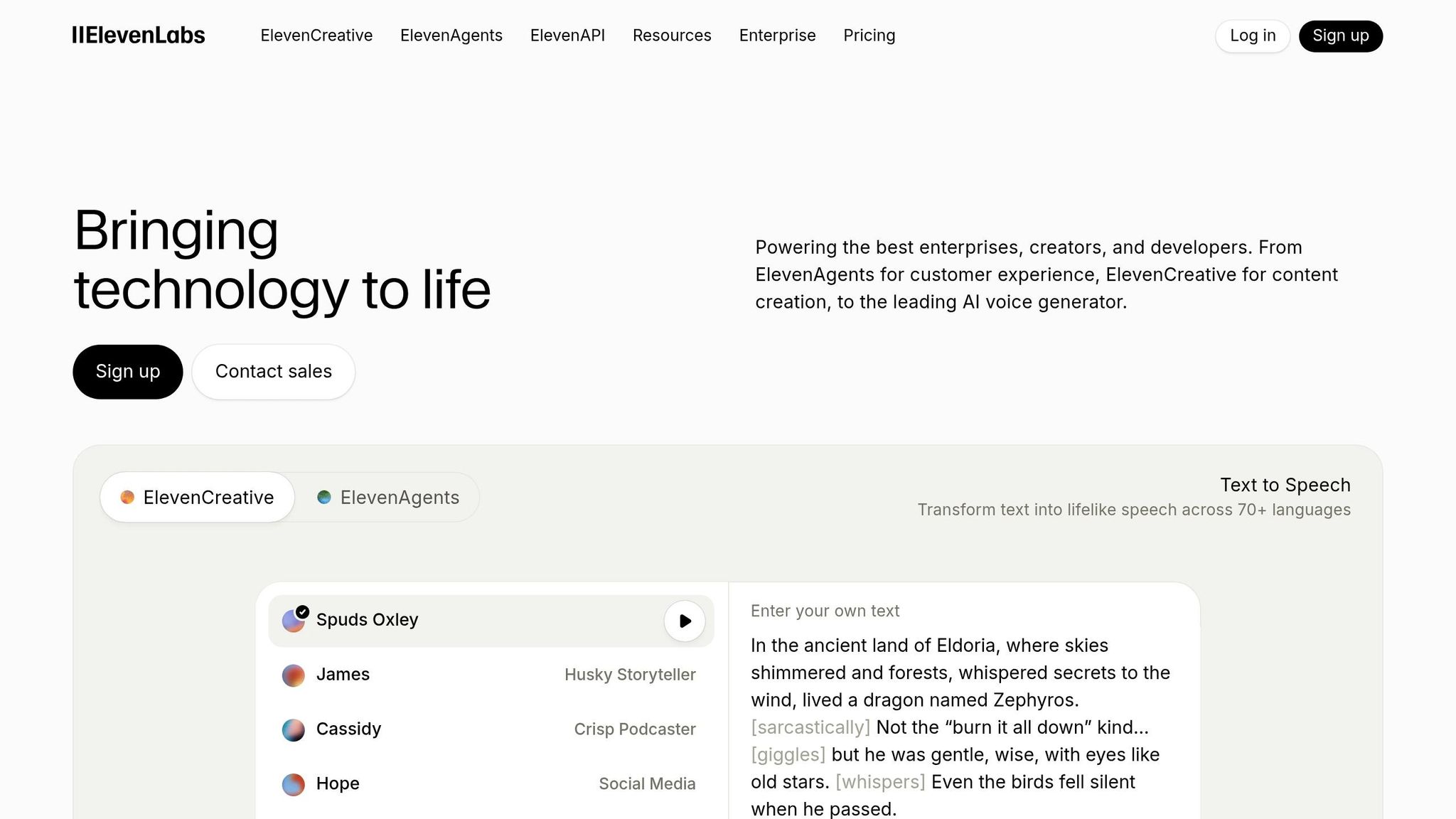
2. ElevenLabs
ElevenLabs specializes in advanced multilingual text-to-speech (TTS) models designed for a variety of applications. The platform's rapid rise in the AI voice space is evident - raising $500 million in a Series D funding round in February 2026 and achieving an $11 billion valuation. These milestones highlight its growing influence in the industry.
Languages and Voices Supported
ElevenLabs offers three distinct models to meet diverse needs:
- Eleven v3: Supports 74 languages, including major global languages and regional dialects like Afrikaans, Assamese, Cebuano, Malayalam, and Welsh.
- Flash v2.5: Optimized for ultra-low latency (~75 ms) and supports 32 languages, making it ideal for real-time applications.
- Multilingual v2: Designed for emotionally rich, long-form content in 29 languages, leveraging deep learning to create natural intonation, emotion, and pacing.
Users can access a library of over 10,000 human-like voices, with character limits varying by model: 5,000 characters for Eleven v3, 10,000 for Multilingual v2, and up to 40,000 for Flash v2.5. These options ensure adaptability across different accents and cultural contexts, enabling realistic and impactful communication.
Accessibility Features
ElevenLabs has made strides in accessibility through its Impact Program, which aims to empower 1 million individuals using AI voice technology. One key tool is ElevenReader, a free app available on iOS, Android, and Chrome. This app converts text into natural-sounding audio, offering critical support for individuals with visual impairments or learning disabilities. As the company explains:
"Accessibility institutes can now further empower people with visual impairments or learning difficulties by providing them with means to easily convert less accessible resources to a medium that suits their needs, both in content and form".
For developers, the platform also provides a TTS API with SDKs for Python, JavaScript, Flutter, Swift, and Kotlin, making it easier to integrate high-quality audio into third-party tools designed for accessibility.
Pricing Model
ElevenLabs offers a flexible seven-tier subscription model: Free, Starter, Creator, Pro, Scale, Business, and Enterprise.
- The Free plan is geared toward non-commercial use, offering basic TTS features but restricting API access to the voice library.
- Paid plans unlock features like commercial usage rights, professional voice cloning, and higher-quality audio. These tiers also provide increased concurrency limits for more demanding applications.
- The Flash v2.5 and Turbo v2.5 models are priced 50% lower per character compared to standard models, making them a budget-friendly choice for high-volume needs.
Additionally, the "free regeneration" feature allows users to regenerate the same content up to two times at no extra cost, provided the text and parameters remain unchanged.
This tiered structure ensures options for both casual users and professionals, catering to a wide range of use cases and budgets.
3. Google Cloud TTS
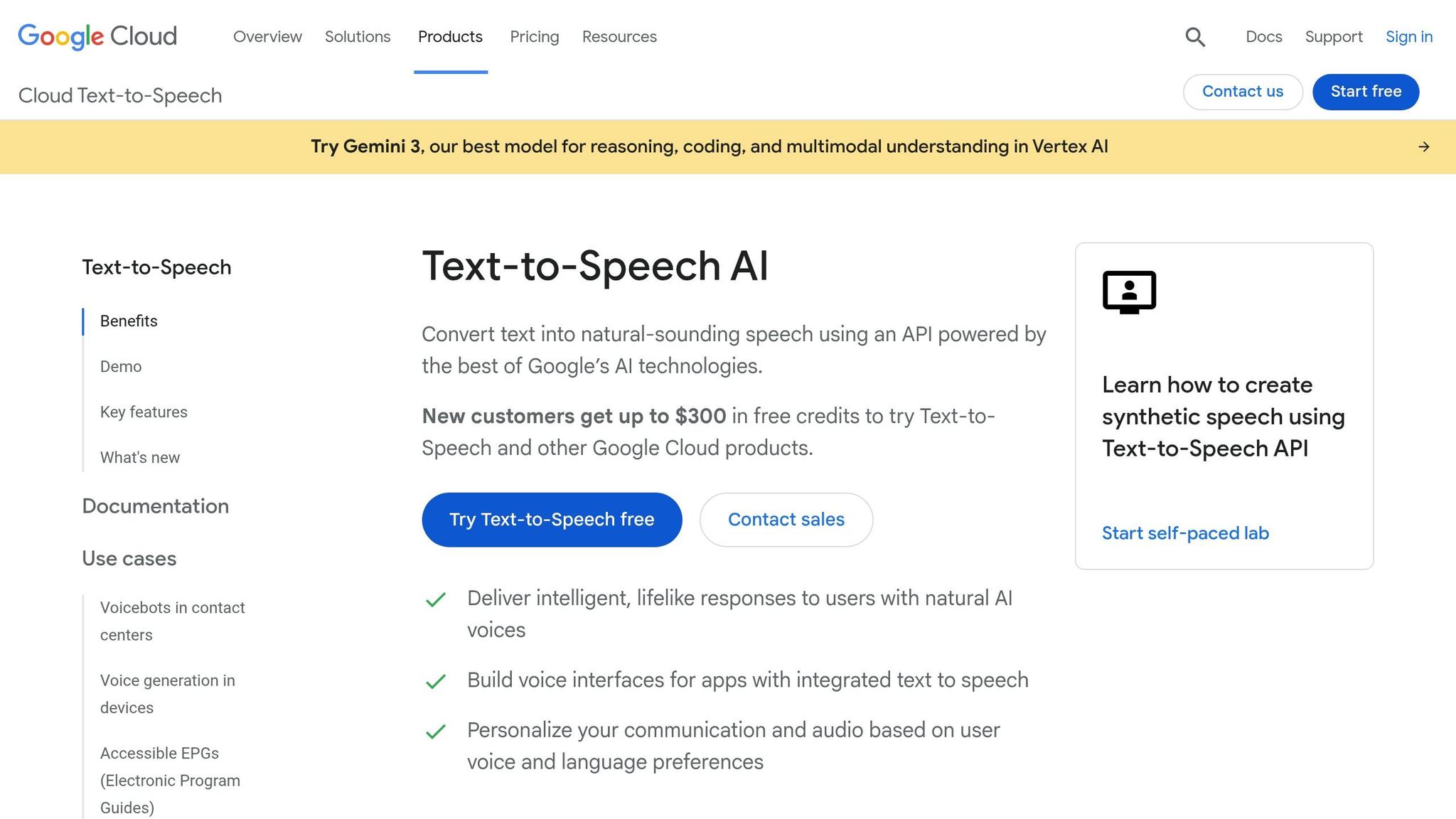
Google Cloud Text-to-Speech delivers high-quality voice synthesis for developers and businesses around the globe. The platform features 380+ voices across 75+ languages and variants, covering major languages like Mandarin, Hindi, Spanish, Arabic, and Russian. It also includes regional variants that reflect local accents and dialects.
Languages and Voices Supported
The platform organizes its voice options into tiers tailored to different needs. WaveNet voices, powered by DeepMind's technology, achieve a MOS score of 4.3 out of 5.0, reducing the quality gap between synthetic and human speech by 70%.
For advanced conversational AI, Chirp 3: HD voices offer 30 unique speaking styles in multiple languages. Users can customize aspects such as style, accent, pace, tone, and emotion. If multilingual capability is required, Polyglot voices can seamlessly switch between languages like French, American English, and Australian English within a single voice model.
Another standout feature is Instant Custom Voice, which creates personalized voice models using just 10 seconds of audio input across more than 30 locales. This is ideal for brands looking to maintain a consistent voice identity or for individuals preserving their unique vocal traits. Additionally, the platform includes features designed to enhance accessibility for a broader audience. This includes tools to convert PDF documents to audio for easier consumption of long-form text.
Accessibility Features
Google Cloud TTS is equipped with tools to meet accessibility needs. For example, it can create Accessible Electronic Program Guides (EPGs) that read TV listings and program details aloud, aiding visually impaired users. Beyond this, it powers voice interfaces for IoT devices, cars, tablets, and PCs, enabling hands-free interaction for those who can't use screens. For web users, a Chrome extension for text-to-speech can further bridge the gap by narrating any webpage instantly.
Developers can fine-tune audio settings to meet specific accessibility requirements. Speaking rates can range from 4x faster to 4x slower than normal, pitch can shift up to 20 semitones higher or lower, and volume gain can adjust between +16 dB and -96 dB. The platform also supports Speech Synthesis Markup Language (SSML), which allows developers to add pauses, adjust pronunciations, and format dates or times for clarity. Its scalability and integration options ensure it can handle a variety of use cases.
Scalability and Integrations
The platform supports both real-time and batch processing through REST and gRPC APIs. For real-time applications, streaming audio synthesis offers low-latency output, with API request times typically ranging from 400 to 600 milliseconds. For longer texts, the Long Audio Synthesis feature can process up to 1 million bytes of input asynchronously.
Google provides a 99.95% uptime SLA for enterprise users, ensuring reliability. Output formats include MP3, Linear16, and OGG Opus, and the service offers "Audio Profiles" to optimize playback for specific devices like headphones or phone lines.
Pricing Model
Google Cloud TTS uses a pay-as-you-go pricing structure, charging based on the number of characters processed each month. New customers receive $300 in free credits to explore the service. Each voice tier also includes a generous free monthly allocation:
| Voice Type | Monthly Free Characters | Price After Free Tier |
|---|---|---|
| Standard Voices | 4,000,000 | $4.00 per 1M characters |
| WaveNet Voices | 4,000,000 | $4.00 per 1M characters |
| Neural2 / Polyglot Voices | 1,000,000 | $16.00 per 1M characters |
| Chirp 3: HD Voices | 1,000,000 | $30.00 per 1M characters |
| Studio Voices | 1,000,000 | $160.00 per 1M characters |
| Instant Custom Voice | None | $60.00 per 1M characters |
For the newer Gemini-TTS models, pricing is token-based. Gemini 2.5 Flash costs $0.50 per 1 million input text tokens and $10.00 per 1 million output audio tokens, while Gemini 2.5 Pro is priced at $1.00 per 1 million input tokens and $20.00 per 1 million output audio tokens. Billing includes all characters, including spaces, newlines, and SSML tags.
4. Amazon Polly
Amazon Polly is a standout in the text-to-speech space, offering an impressive range of voices and regional accents. With over 100 voices across 41 language variants, it provides a flexible solution for developers and businesses alike. A key highlight is its support for regional accents, particularly in English, which includes variants for the US, UK, Australia, India, Ireland, New Zealand, Singapore, South Africa, and Wales. Other major languages also come with regional options, such as French (France, Belgium, Canada), Spanish (Spain, Mexico, US), and Portuguese (Brazil, Portugal).
Languages and Voices Supported
Amazon Polly offers four distinct voice engines designed for various use cases:
- Standard voices: Built with concatenative synthesis, suitable for basic applications.
- Neural voices: Delivering high-quality, natural-sounding output across 36 language variants.
- Long-Form voices: Ensuring consistent quality for extended content.
- Generative voices: Providing speech with a conversational and emotionally expressive tone.
Additionally, Polly includes a bilingual voice capable of switching seamlessly between English and Hindi. This broad selection allows businesses to deliver clear and relatable audio for global audiences. For example, Duolingo leverages Polly to power its pronunciation features, helping users hear accurate pronunciations in multiple languages.
Accessibility Features
Amazon Polly goes beyond standard text-to-speech by incorporating Speech Marks metadata, which synchronizes audio with visual elements like karaoke-style text or facial animations. These features are especially useful for creating accessibility tools. The platform also supports time-driven prosody adjustments, ensuring that translated audio aligns perfectly with video timing. Another helpful feature is Custom Lexicons, which allow developers to fine-tune pronunciations for brand names, acronyms, or industry-specific terminology.
Scalability and Integrations
As a fully managed cloud service accessed via API, Polly makes scaling speech synthesis straightforward. It supports popular SDKs for platforms like iOS and Android and integrates seamlessly with services such as Amazon Connect, Amazon Chime, and even third-party platforms like Genesys Cloud CX. Audio output can be generated in MP3, Vorbis (OGG), and Raw PCM formats with sampling rates of 8 kHz, 16 kHz, 22 kHz, or 24 kHz. This flexibility, combined with a pay-as-you-go pricing model, ensures that Polly can handle projects of any size.
Pricing Model
Amazon Polly's pricing is based on the number of characters processed each month, with a pay-as-you-go structure. New AWS users benefit from up to $200 in Free Tier credits, along with a generous free allocation during their first 12 months:
| Voice Engine | Price per 1M Characters | Free Tier (Monthly for 12 Months) |
|---|---|---|
| Standard | $4.00 | 5,000,000 characters |
| Neural | $16.00 | 1,000,000 characters |
| Generative | $30.00 | 100,000 characters |
| Long-Form | $100.00 | 500,000 characters |
Once generated, speech can be cached and replayed without incurring additional costs. Requests for Speech Marks metadata are billed at the same rate as the selected voice engine, keeping costs transparent and manageable.
5. Microsoft Azure AI Speech
Microsoft Azure AI Speech provides a vast collection of 400+ neural voices in 140+ languages and locales. Among these are specialized voices like "JennyMultilingual" and "RyanMultilingual", capable of fluently speaking 41 different languages and accents. The platform's automatic language detection ensures natural pronunciation and intonation without requiring manual adjustments. By 2024, the library expanded to include over 60 multilingual voices with lifelike quality.
Languages and Voices Supported
For English, the platform offers 15+ regional variants, covering areas like Australia, India, Kenya, Nigeria, and South Africa. Spanish speakers have access to 20+ locales, including regions such as Argentina, Equatorial Guinea, and multiple countries across Central and South America. Beyond the prebuilt voices, businesses can develop Custom Neural Voices tailored to their brand, with the added flexibility of cross-lingual capabilities that allow these voices to speak dozens of languages. Azure AI Speech also supports SSML (Speech Synthesis Markup Language) for fine-tuning elements like pitch, rate, and pronunciation. Additionally, viseme data for en-US voices enables facial animations, making the platform useful for lip-reading applications. These features enable businesses to create highly personalized and accessible solutions.
Accessibility Features
In 2024, healthcare technology company healow utilized Azure AI Speech for their Sunoh.ai platform, cutting the administrative workload for U.S. clinicians by nearly 50% and saving users up to two hours daily. Similarly, Hughes, a division of EchoStar, integrated Azure AI tools to streamline call center operations. This resulted in the automation of processes and saved the company thousands of work hours through tailored transcription and voice models.
Scalability and Integrations
Azure AI Speech seamlessly integrates with various environments, leveraging Microsoft's ecosystem. It connects with tools like Azure OpenAI to combine speech with advanced models such as GPT-4, Azure Translator for real-time language translation, and Azure Language for conversational AI applications. Developers can use SDKs for programming languages like C#, C++, Java, Python, and JavaScript, or opt for REST APIs for HTTP-based integrations. Deployment options include cloud, on-premises, and edge setups using containers. For scenarios where cloud access is limited, embedded speech enables on-device functionality. For those without coding expertise, the Speech Studio's Audio Content Creation tool offers a user-friendly, no-code solution.
Pricing Model
Azure AI Speech combines advanced features with competitive pricing, making it a strong choice for enterprise-level applications. The free tier (F0) provides 0.5 million characters per month for neural text-to-speech, and new users benefit from a $200 Azure free credit. Pay-as-you-go pricing is set at $15 per 1 million characters for standard neural voices. For higher usage, commitment tiers start at $960 per month for 80 million characters, lowering the cost to $12 per 1 million characters. Custom Professional Voice synthesis costs $24 per 1 million characters, with training priced at $52 per compute hour and endpoint hosting at $4.04 per model per hour.
6. Murf AI
Murf AI features over 300 ultra-realistic voices in more than 40 languages, offering a variety of accents such as American, British, Australian, Indian, and Scottish English. Other language options include French and Canadian French, Mainland and Mexican Spanish, as well as Brazilian and European Portuguese. Its MultiNative Technology is a standout feature, enabling a single AI voice to fluently speak multiple languages while maintaining voice consistency. This is particularly advantageous for global brands needing uniform narration across diverse markets.
Languages and Voices Supported
Murf's voice library provides 20+ narration styles, including Promotional, Documentary, Newscast, Conversational, Luxury, and Empathetic options. Voices are categorized by age - Kid/Tween, Young Adult, and Middle-Aged - allowing creators to fine-tune their audio content. In a test using 4,710 words from 300,000 multilingual news sentences, Murf's text-to-speech model achieved an impressive 99.38% pronunciation accuracy. Additionally, the Pronunciation Editor lets users customize how specific terms, such as brand names or technical jargon, are pronounced, ensuring consistency across projects.
Accessibility Features
The platform includes the Murf Reader, a tool designed to convert PDFs, articles, and documents into audio, making it easier for individuals with visual impairments or reading disabilities to access information. This feature is also valuable in eLearning environments for students with dyslexia and in healthcare settings for individuals with mobility, speech, or visual challenges. Murf adheres to compliance standards such as SOC 2 Type II, ISO 27001, GDPR, and HIPAA.
Scalability and Integrations
Murf integrates seamlessly with popular tools like Canva, Google Slides, and Microsoft PowerPoint, making it simple to add voiceovers to presentations. It also supports professional creative software, including Adobe Premiere Pro and Adobe Captivate, through a Windows voices installer compatible with Microsoft SAPI. For developers, the Murf Falcon API offers a model latency of under 55ms and a time-to-first-audio of around 130ms, with infrastructure capable of handling up to 10,000 concurrent calls without performance issues.
Pricing Model
Murf provides a Free Plan that includes 10 minutes of voice generation and 2 projects, though downloads and commercial rights are not included. The Creator Plan costs $19 per month (billed annually) or $29 per month (billed monthly), offering unlimited downloads and commercial usage. The Business Plan starts at $66 per month (billed annually) or $99 per month (billed monthly), adding team collaboration tools and an AI Voice Changer. For larger-scale needs, the Enterprise Plan provides custom pricing, SSO, and dedicated account management. API access to the Murf Falcon service is available at $0.01 per minute of audio generated.
7. PlayHT
PlayHT stands out as a versatile AI text-to-speech (TTS) tool, offering extensive multilingual support and customization options. With coverage for 142 languages and a library of over 800 voices, it's designed to meet both real-time interaction needs and accessibility requirements. For those looking to implement these features, getting started with TTS Buddy provides a comprehensive suite for web and API integration. The platform delivers an average API latency of 150-250ms, making it well-suited for real-time applications. It boasts a voice quality score of 4.2/5.0 and a user rating of 4.6/5 from 293 reviews as of early 2026. This combination of features ensures natural, regional accent reproduction and high-quality audio output.
Languages and Voices Supported
PlayHT excels in offering regional accents and natural-sounding voices, avoiding the overly synthetic tones common in some TTS tools. With full SSML (Speech Synthesis Markup Language) support, it ensures smooth pacing and realistic prosody, making it ideal for long-form content. Users can tweak pitch and speed settings, which is particularly helpful for correctly pronouncing brand names or technical terms that might otherwise be misinterpreted.
Accessibility Features
One of PlayHT's key strengths is its ability to convert text into spoken audio, making it an essential tool for people with visual impairments or learning disabilities. Its real-time audio conversion capabilities are especially useful for interactive applications, such as in-app voice guidance. The platform also lets users customize playback settings to better meet individual accessibility needs, reinforcing its role as a reliable solution for enhancing inclusivity.
Scalability and Integrations
PlayHT is built with scalability in mind. Developers can leverage its low-latency API, which supports up to 1,000 requests per hour and 20 simultaneous requests. For content creators, the platform offers a WordPress plugin, simplifying integration with content management systems. As a fully cloud-based service, it includes instant voice cloning as a standout feature, adding another layer of customization.
Pricing Model
PlayHT operates on a subscription model, starting with a free tier that provides 12,500 characters per month for non-commercial use. The Starter Plan, priced at $31 per month, includes 300,000 characters and commercial usage rights. For more advanced needs, the Professional Plan at $99 per month offers 2,000,000 characters, premium voices, and instant cloning. Enterprises with higher demands can opt for custom pricing, which includes volume discounts, SLA guarantees, and dedicated support. Developers seeking predictable costs can also choose flat-rate API pricing.
Comparison Table
The table below outlines key metrics for various text-to-speech tools, including language options, voice availability, quality ratings, pricing, and ideal use cases.
| Tool | Languages | Voices | MOS Score | Starting Price | Best Use Case |
|---|---|---|---|---|---|
| TTSBuddy | 30+ | 300+ | N/A | Free | Accessibility, studying, webpage-to-audio conversion |
| ElevenLabs | 70+ | 1,000+ | 4.5/5.0 | $5/month | Premium content, audiobooks, voice cloning |
| Google Cloud TTS | 50+ | 380+ | 4.3/5.0 | Free tier; $4 per 1M chars | High-quality apps, multilingual accuracy |
| Amazon Polly | 40+ | 100+ | 4.0/5.0 | $4 per 1M chars | High-volume alerts, AWS integrations |
| Microsoft Azure AI Speech | 150+ | 600+ | 4.2/5.0 | $15 per 1M chars | Enterprise IVR, compliance-heavy builds |
| Murf AI | 20+ | 200+ | 4.0/5.0 | $19/month | Corporate training, e-learning |
| PlayHT | 142 | 800+ | 4.2/5.0 | $31/month | Multilingual blogs, WordPress integration |
ElevenLabs stands out with a 4.5/5.0 MOS score, delivering near-human voice quality. Microsoft Azure and PlayHT excel in language diversity, each supporting over 140 languages, making them ideal for global audio needs. Google Cloud TTS provides a generous free tier of up to 4 million characters monthly, while TTSBuddy remains entirely free, catering especially to students and those with visual impairments.
For high-volume processing, Amazon Polly offers cost-effective solutions but with limited emotional nuance. Murf AI impresses with 99.38% pronunciation accuracy across 300,000 multilingual sentences and includes word-level editing. For compliance-heavy projects like SOC 2, HIPAA, or FedRAMP, Microsoft Azure and Amazon Polly are reliable choices.
This breakdown highlights the distinct strengths of each tool, helping you choose the best fit for your text-to-speech requirements.
Conclusion
AI text-to-speech tools offer a variety of features tailored to meet the needs of users in different fields. ElevenLabs stands out for producing lifelike voice quality, making it perfect for audiobooks and podcasts. Murf AI shines with its word-level editing, making it a great choice for e-learning and corporate training. Microsoft Azure AI Speech guarantees enterprise-level reliability with 99.9% uptime and FedRAMP certification. Amazon Polly is a budget-friendly option for handling high-volume IVR tasks. Google Cloud TTS combines quality and affordability, thanks to its free tier and DeepMind WaveNet technology. PlayHT caters to content creators with over 800 voices in 142 languages and seamless WordPress integration. Meanwhile, TTSBuddy offers completely free access, featuring 300+ voices in 30+ language modes, along with tools like webpage-to-conversation and one-click Markdown conversion, making it accessible to a broad audience.
Take advantage of free tiers to evaluate voice quality, pronunciation, and performance for your specific needs. For real-time applications, ensure the tool meets your latency requirements. These platforms not only deliver realistic voice output and multilingual capabilities but also improve accessibility for a wide range of users.
With the global AI voice market expected to grow from $4.16 billion in 2025 to $20.71 billion by 2031, the evolution of these tools will continue. Choose the platform that aligns best with your goals - whether you're aiming for lifelike voice generation, scalable solutions, or improved accessibility.
FAQs
How do I choose the right multilingual TTS tool for my use case?
When selecting a multilingual text-to-speech (TTS) tool, it's important to weigh several factors. Look at the range of supported languages and accents, as well as the naturalness of the voices provided. For projects that require real-time capabilities, consider how well the tool handles scalability and integration, along with its overall cost-efficiency.
For example, TTSBuddy offers a solid choice with support for 30+ language modes and 300+ voices, making it a flexible option for various needs. Ultimately, the best tool will align with your specific project goals and the preferences of your target audience.
What should I test in a free tier before paying?
Before diving into a paid text-to-speech service, take advantage of the free tier to evaluate these critical features:
- Voice Quality: Listen closely to see if the voices sound natural and engaging.
- Language and Accent Options: Make sure the service supports the specific languages and accents you require.
- Usage Limits: Review any character or time restrictions to understand how much you can test.
- Export Features: Confirm you can download audio files without unnecessary limitations.
- Customization Tools: Experiment with pronunciation adjustments and voice settings to see how much control you have.
These steps will help you determine if the service aligns with your needs.
How does character-based TTS pricing work?
Character-based TTS pricing works by charging you based on the number of characters processed. Most plans or usage tiers come with specific character limits, which could be allocated daily or monthly. These limits determine how much text you're able to convert into speech under your selected plan.